
The Snowdrop Philosophy
On finding a home that met me where I was

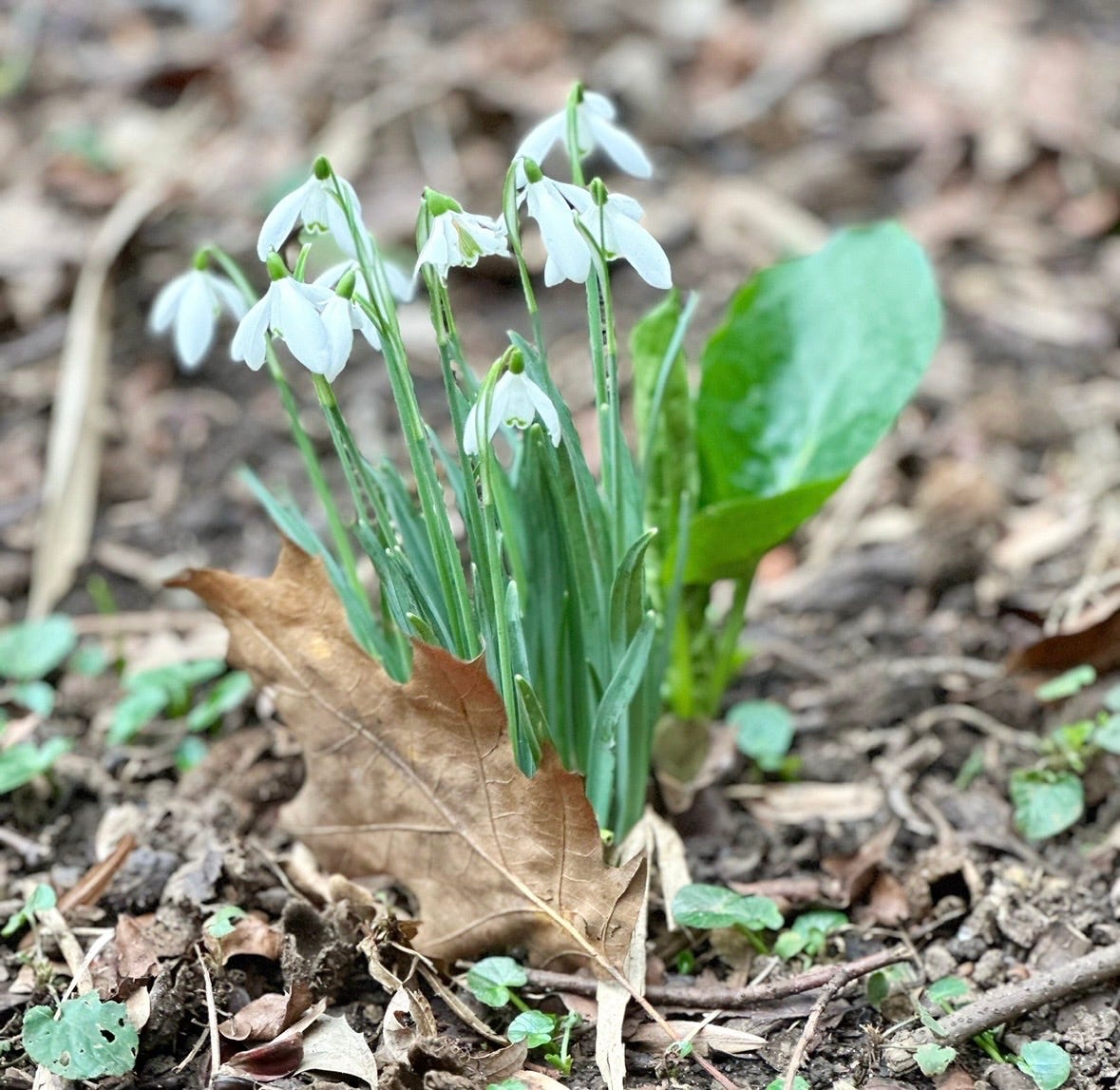
Snowdrops were in bloom the day we first viewed this cottage.
I don't remember noticing much else.
My husband was busy weighing up the practicalities: it was smaller than our previous home, the bathrooms were dated, there was no garage, no study, and instead of mains drainage there was a septic system which was completely new to us. All perfectly sensible things to think about when deciding whether somewhere could become your home.
I, on the other hand, couldn't take my eyes off the snowdrops.
They lined the stream that winds through the garden, their white flowers scattered beneath the trees like little signs that winter was beginning to loosen its grip. I was mesmerised the moment I saw them.
I’ve always loved snowdrops, but there was something about seeing them there that felt almost magnetic. Once I'd noticed them, nothing else seemed to matter.
At the time, I thought I'd simply fallen in love with the garden but looking back, I think it was something much deeper.
Before illness reshaped my life, searching for snowdrops had become one of my favourite rituals of early spring. Each year we'd visit woodlands, National Trust gardens and corners of the countryside where they carpeted the forest floor. Finding them always felt like a promise that brighter days were on their way.
Then, almost without noticing, those journeys began to slip away from me.
Not because I stopped loving them, but because they slowly began to ask more of me than I could give. Winter had become harder. The cold settled deep into my bones. The travelling took more energy than I realised and sometimes the walking left me needing days to recover. Gradually, something I loved became something my body could no longer do so easily.
Some years, I missed the snowdrops altogether.
I'd watch my husband head off on long countryside walks while I stayed at home.
I'd tell him to enjoy himself, and I meant it.
But once the front door closed behind him, I'd often find myself sitting with a sadness I couldn't quite put into words.
It felt like I wasn't just losing the ability to visit the places I loved, I was losing access to a part of life that had been woven into my wellbeing and my sense of who I was.
I wasn't resentful of him - I was grieving the life I used to share with him. It was hard not to feel trapped inside a body that no longer always allowed me to follow.
Sometimes I'd put on recordings of birdsong or watch videos of woodland walks, trying to recapture something I couldn't quite reliably reach anymore.
They brought a little comfort, but they also reminded me of what I was missing.
I didn't realise then that I wasn't just missing the countryside. I was missing the feeling of belonging within it.
Standing in that garden looking at the snowdrops, I don't think I was really choosing a cottage at all.
I think I was recognising something I'd been quietly grieving.
The snowdrops weren't hidden away in woodland miles from home anymore.
They were already waiting beside the stream.
It took me months to understand why that moment affected me so deeply.
Looking back, I realise I wasn't simply choosing somewhere beautiful to live. I was choosing a place where nature could come to me instead of asking me to go to it.
That realisation has stayed with me ever since.
Last year, while I was recovering from surgery, my son helped me plant pumpkins and this spring my husband carefully dug the patch out again after winter had reclaimed it.
Neither of them are gardeners - they just knew how much the pumpkins had come to mean to me.
It was their way of bringing a little more of the countryside back within my reach.
I spent hours sitting beside them, watching the leaves slowly unfurl and the flowers begin to open.
It wasn't the long countryside walks I'd once loved. But it still gave me that same feeling of being connected to something living and growing.
It made me realise that the pumpkins were never really about pumpkins. They were another version of the snowdrops that first drew me here.
Sometimes adaptation isn't about letting go of what matters. It's about finding a different way to stay close to it.
And once I'd recognised that in my own life, I started noticing other people's snowdrops too.
Not the flowers themselves.
But the different ways people stay connected to the things that matter when life no longer lets them reach them in quite the same way.
A parent rediscovering stories through audiobooks because there's very little uninterrupted time to sit with a novel.
A grandparent introducing their grandchild to tennis because they're no longer able to play.
Someone finding friendship through an online community when leaving home has become difficult.
A neighbour who can no longer sing in a choir but still fills the house with music while they cook.
A commuter getting off the train one stop early and choosing the riverside path home because those few extra minutes by the water help them feel like themselves again.
Different lives and different circumstances. Yet perhaps the same instinct: to keep hold of the things that help us feel alive by finding another way to reach them.
I've started thinking of it as the Snowdrop Philosophy.
If I'm honest, even if I had every option in the world now, I think I'd still choose this cottage.
Not because it's perfect.
But because, before I understood it myself, it met me where I was.
This sentence resonates: “Not because I stopped loving them, but because they slowly began to ask more of me than I could give” defines a feeling I’ve been healing from this past year. Thank you. And I am so glad you have your garden.
I love this. I can no longer garden or walk in the bush. But thank goodness my family can and I am able to watch the trees and birds and wildlife and still feel that deep peace that the natural world brings us.